
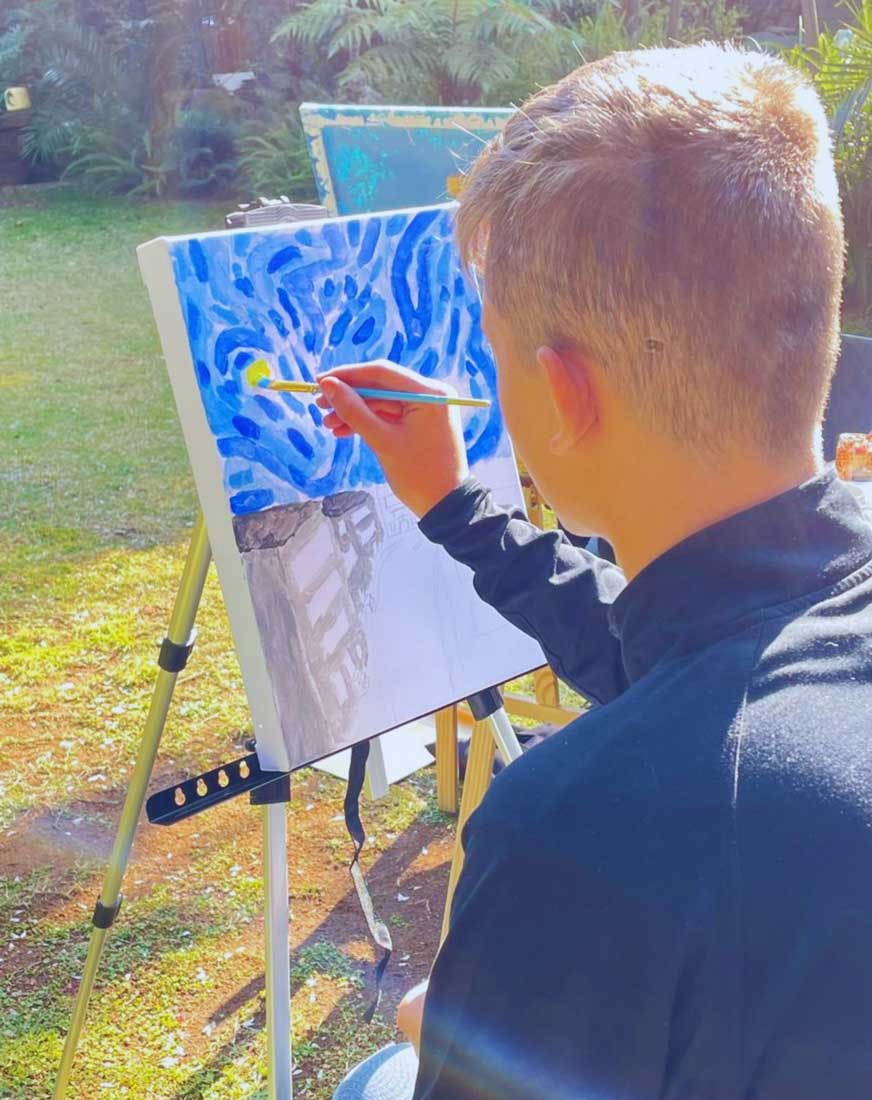
Why Visual Arts is One of the Most Valuable School Subjects
If you’re a parent considering subject choices for your child, you may have heard this before: “Art is nice, but is it really useful?”
The short answer is yes – and the long answer might change the way you think about education entirely.
Visual Arts is one of the most misunderstood subjects in the South African CAPS curriculum. It’s often seen as a “light” option – something for creative kids who aren’t interested in “serious” subjects. But the reality is very different. Visual Arts develops a set of cognitive, emotional, and professional skills that are not only valuable in their own right, but transferable to virtually every career path.
At Bud & Blossom Creatives, we’ve spent over 20 years watching Visual Arts transform learners – building confidence, sharpening thinking, and opening doors that many families never expected.
Here’s why this subject deserves far more respect than it usually gets.
Beyond Drawing – What Visual Arts Really Teaches
When most people think of Visual Arts, they picture drawing and painting. And while those are certainly part of it, they represent only a fraction of what the subject actually develops.
The CAPS Visual Arts curriculum is designed to build:
Observation skills
the ability to look deeply, notice detail, and interpret what you see
Analytical thinking
evaluating composition, colour theory, and design decisions
Conceptual development
generating original ideas and developing them through research and experimentation
Visual communication
expressing complex thoughts and emotions through image, form, and design
Art historical knowledge
understanding cultural context, movements, and the role of art in society
These are not niche artistic skills. They are foundational cognitive abilities that support success in science, business, technology, medicine, and every field that requires someone to observe, think, and communicate clearly.
Visual Arts doesn’t just teach learners how to make art. It teaches them how to think.
Critical Thinking and Problem-Solving Through Art
Every artwork is a series of decisions. What medium to use. How to compose the image. Which colours create the right mood. How to balance technical execution with personal expression. What to keep – and what to discard.
This constant cycle of decision-making, evaluation, and revision is exactly what develops critical thinking.
In Visual Arts, there is rarely one “correct” answer. Learners must:
This process mirrors the problem-solving approach used in engineering, medicine, business strategy, and design thinking. The learner who can navigate ambiguity in art is the same learner who can navigate ambiguity in life.
And there’s another benefit that’s often overlooked: resilience. Art doesn’t always go as planned. Paint bleeds. Perspectives distort. Ideas that seemed brilliant on paper don’t translate to canvas. Learning to work through failure – to adapt, adjust, and try again – builds emotional resilience that serves learners well beyond the classroom.
Career Paths That Start With Visual Arts
One of the most persistent myths about Visual Arts is that it leads to limited career options. The truth is the opposite.
Visual Arts graduates go on to pursue careers in:
- Graphic Design & Branding – every company needs visual identity
- Architecture & Interior Design – spatial thinking starts with visual literacy
- Animation & Motion Graphics – film, gaming, advertising, educational content
- UX/UI Design – one of the fastest-growing and highest-paying creative fields globally
- Film & Video Production – storyboarding, art direction, visual effects
- Fashion Design – textile design, pattern making, visual storytelling
- Game Design – character art, environment design, concept art
- Photography – commercial, editorial, documentary
- Art Education – teaching, tutoring, curriculum development
- Fine Art – exhibitions, commissions, gallery work
And it’s not just about traditionally “creative” careers. The thinking skills developed through Visual Arts – observation, analysis, communication, problem-solving – are valued in medicine, law, business, and technology.
Our own educator, Merandie de Jager, is a perfect example. With a BA in Film Arts specialising in 3D Animation, she spent 5+ years working as a professional 3D Animation Generalist before joining Bud & Blossom to guide the next generation. Her career path began with a foundation in Visual Arts.
Visual Arts is not a dead-end subject. It’s a gateway.
How Bud & Blossom Teaches Visual Arts Differently
Not all art education is created equal. At Bud & Blossom Creatives, we’ve built our approach around a few non-negotiable principles:
Small groups, individual attention
We never teach to the crowd. Every learner receives personal feedback, guided mentorship, and the space to develop at their own pace.
Structure that creates safety
Creativity thrives within boundaries. Our curriculum is carefully structured – not rigid, but intentional – so learners always know what’s expected and can focus on growing within that framework.
Balance of practical and theory
We don’t just teach technique. We teach context, meaning, and critical analysis alongside practical skill – because understanding why you create is as important as knowing how.
Inclusive by design
Our studio environment is calm, supportive, and adapted for neurodivergent and LSEN learners. We believe every learner deserves a space where they can thrive.
Proven results
100% pass rate. Registered Impaq assessor. Best Educator award (2025). These aren’t marketing claims – they’re the outcome of 20+ years of dedicated, structured Visual Arts teaching.
Frequently Asked Questions
Give Your Child the Advantage of Creative Thinking
Visual Arts is not a luxury. It’s a foundation – for critical thinking, emotional resilience, creative confidence, and career readiness.
If you’re considering Visual Arts for your child, or if they’re already passionate about art and need structured support, we’d love to help.